
The Ford Bronco/Jeep Wrangler battle has car fans talking, and for good reason. These tough SUVs draw in thrill-seekers who want to tackle everything from Chester County’s gentle slopes to the Pocono Mountains’ rocky paths. At John Kennedy Ford Conshohocken, we’ll guide you through the differences between the Jeep Wrangler and the Ford Bronco to help you decide which you need for your Pennsylvania adventures.
Design and Aesthetic Differences
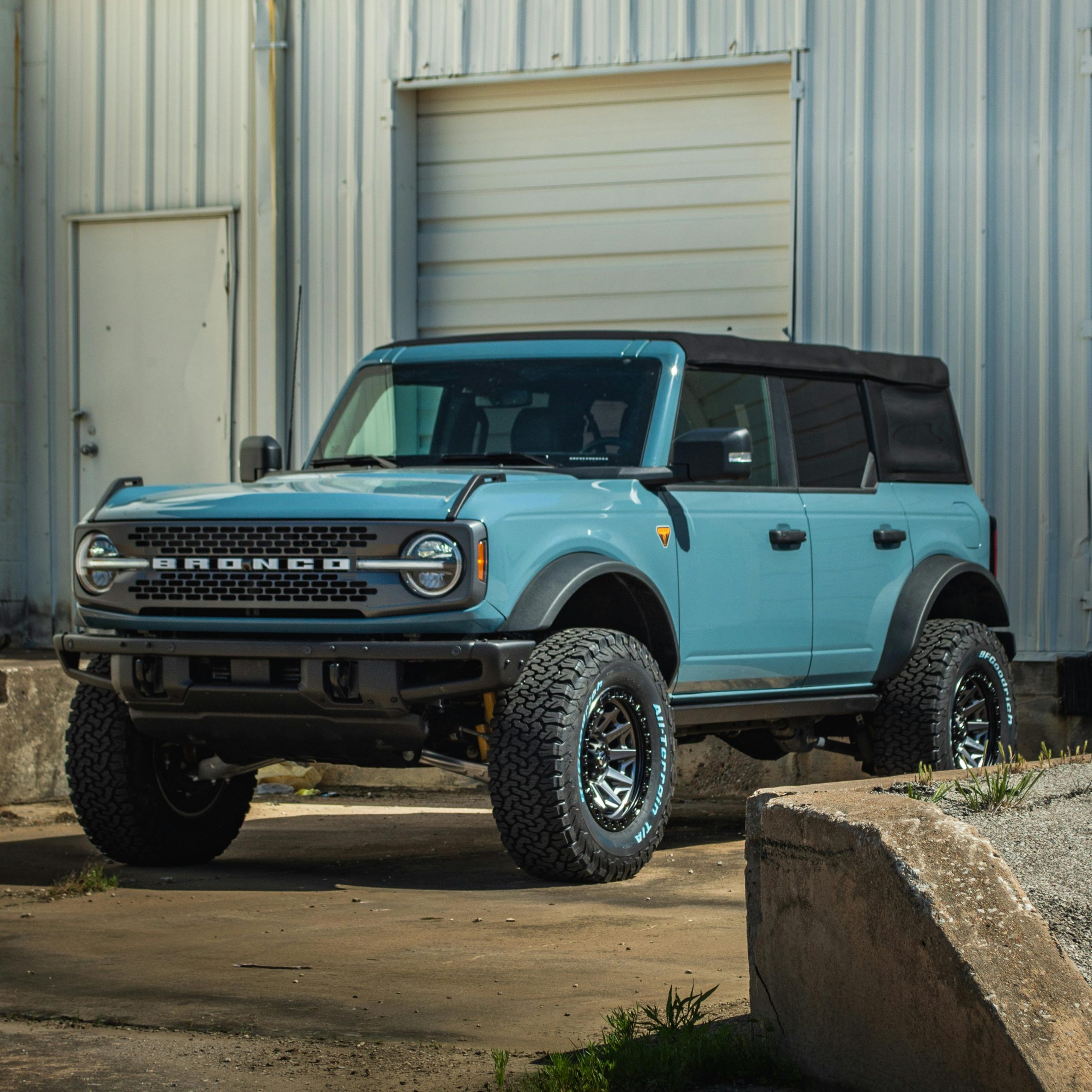
Ford’s Bronco brings a fresh take on off-road style with squared-off panels and wide wheel arches. Its bold front face strikes a balance between tough and modern. Jeep’s Wrangler keeps its classic look with the famous seven-slot grill and round headlights. Its boxy shape hasn’t changed much, a nod to military roots that Jeep fans recognize.
Two-door Wranglers are 166.8 inches long, 73.9 inches wide, and 73.6 inches tall. Their Bronco counterparts are a bit longer at 173.7 inches, wider at 75.9 inches, but lower in height at 71.9 inches. Four-door Wranglers measure 188.4 inches long, keeping the same width and height as their two-door brethren. Four-door Broncos extend to 189.4 inches, also retaining the width and height of their smaller siblings. Two-door Broncos span 100.4 inches between wheels against their Wrangler counterparts’ 96.8 inches. The wheelbase figures for the four-door Bronco and Wrangler variants are 116.1 and 118.4 inches, respectively.
Both vehicles have removable tops and doors, though they apply different approaches. In just a few minutes, you can remove the Ford Bronco’s roof and install a UV-resistant Bimini soft top. This replacement keeps air flowing and prevents heat buildup during sticky Pennsylvania summers. Jeep offers various roof choices: the classic Sunrider soft top, three-piece hard options, and the fancy Sky One-Touch Power Top. Four-door Broncos let you remove the doors and store them onboard in optional bags.
Performance Capabilities
The Bronco vs. Wrangler comparison sees these rivals taking different approaches to power. The Bronco’s engine options begin with a 300-horsepower 2.3-liter EcoBoost four-cylinder, giving you 325 lb-ft of torque. You can also choose a 330-horsepower 2.7-liter EcoBoost V-6 with 410 lb-ft of torque or a 418-horsepower 3.0-liter EcoBoost making 440 lb-ft of torque. Jeep counters with a 3.6-liter V-6 at 285 horsepower and 260 lb-ft of torque, a 2.0-liter turbo at 270 horsepower and 295 lb-ft of torque, and a 6.4-liter V-8 with 470 horsepower and 470 lb-ft of torque.
Four-door Wranglers with automatic transmission can tow 5,000 pounds; the Bronco’s maximum, with the 3.0-liter engine and Trailer Tow Package, is 4,500 pounds. The Bronco Raptor accelerates from 0 to 60 mph in 5.6 seconds, with the Wrangler Rubicon 392 achieving this in 4.5 seconds. The Bronco delivers power more smoothly for daily drives, while the Wrangler offers raw, punch-you-back acceleration. The Bronco’s 2.3-liter turbo four gets 20 mpg in the city and 22 mpg on the highway; the Wrangler’s 3.6-liter V-6 manages 17 mpg city/23 mpg highway.
Off-Road Prowess
Ford’s G.O.A.T. (Goes Over Any Terrain) modes offer seven settings that tweak your ride for whatever surface you’re tackling. Impressive technology features, such as Trail Turn Assist, Trail 1-Pedal Drive, and Trail Control, work together to make you look like an off-road pro. Choose the Sasquatch Package, and you’ll get bigger tires, locking differentials, and more ground clearance for those wild weekends at Pennsylvania’s state forests.
Jeep has its four-wheel-drive systems, including Command-Trac, Selec-Trac, Rock-Trac, and Selec-Terrain. Along with that bulletproof, solid front axle design, they’ve given the brand decades of trail trustworthiness. The electronic sway bar disconnect provides the Wrangler with flexible wheel movement when climbing over rocks. The Wrangler with the Xtreme 35 Package gives you 12.9 inches of ground clearance; with the Bronco Raptor, you get 13.1 inches.
The Wrangler has 47.4-degree approach and 40.4-degree departure angles, while the Bronco Raptor manages 47.2-degree approach and 40.5-degree departure angles. In fords, the Bronco handles 33.5-36.4 inches of water while the Wrangler manages just 32.5-34 inches.
Interior Comfort and Technology
Inside, these SUVs take different paths to mixing toughness with comfort. The Bronco range gives you 99-108.2 cubic feet for passengers, while the Wranglers offer 103.7-104 cubic feet. Four-door Broncos boast 77.6-83 cubic feet of cargo volume, outstripping their Wrangler counterparts’ 72.4 cubic feet. That extra room makes a real difference when you’re packing for a weekend at Pennsylvania’s state parks or bringing home bulky items from the hardware store.
The Bronco boasts a massive 12-inch SYNC 4 touch screen that handles wireless Apple CarPlay and Android Auto. There’s also a 12-inch digital gauge cluster displaying all your vehicle information. The Wrangler uses Uconnect screens ranging from 8.4 to 12.3 inches and has an eight-speaker audio system that works well but doesn’t quite match up. The Bronco’s marine-grade vinyl seats and rubber floors with drain plugs make the interior easy to clean. Both vehicles give you six-way adjustable driver’s seats to keep you comfortable on long trips through Pennsylvania’s back country.
Safety Features and Ratings
Safety gear reveals some significant gaps between these trail-ready SUVs. The Bronco comes standard with automatic emergency braking and scores “Good” ratings in multiple Insurance Institute for Highway Safety (IIHS) crash tests. The Wrangler doesn’t include automatic emergency braking unless you pay extra, and it gets lower safety scores from the National Highway Traffic Safety Administration and IIHS. Ford’s Co-Pilot360 package wraps driver assists in one neat bundle, while Jeep makes you add its Active Safety Group on many models.
If you roll your vehicle or get stuck somewhere remote, this safety technology suddenly means a lot more than it did in the showroom. Families especially might sleep better knowing the Bronco has their backs when the trail gets rough.
Which Adventure-Ready SUV Suits Your Southeastern Pennsylvania Lifestyle?
Your perfect pick between the Bronco and the Wrangler depends on what matters most to you. The Bronco brings modern technology, better fuel economy, stronger safety ratings, more cargo room, and clever off-road systems. The Wrangler counters with decades of proven toughness, stronger towing muscle, extensive availability of aftermarket parts, and that legendary Jeep culture spanning generations.
When commuting daily from the suburbs to Philadelphia, the Bronco’s fuel savings add up. If you have children, those better safety scores matter. The Bronco’s extra cargo space accommodates more gear for weekend camping trips, and if you’re new to off-roading, the G.O.A.T. modes make trail driving less intimidating. The Wrangler is only likely to suit your needs better if you crave that classic Jeep wave from fellow owners, want to join established trail groups, or need to tow heavier loads. In the Jeep Wrangler vs. Ford Bronco comparison, the latter is the clear winner.
Experience the 2025 Bronco at John Kennedy Ford Conshohocken
If you’re ready to experience the 2025 Ford Bronco firsthand, visit our dealership in Conshohocken, Pennsylvania. Our knowledgeable team will answer any questions about this robust vehicle and help you choose the proper setup for your lifestyle. Fill in our online form to schedule a test-drive, or contact us for any other inquiry.
Connect with us


- July 2026
- June 2026
- April 2026
- March 2026
- February 2026
- January 2026
- December 2025
- November 2025
- October 2025
- September 2025
- August 2025
- July 2025
- June 2025
- May 2025
- April 2025
- March 2025
- February 2025
- January 2025
- December 2024
- November 2024
- October 2024
- September 2024
- August 2024
- April 2024
- March 2024
- February 2024